Introduction
Combat pilots have always preferred to fly, and throughout history that preference has shaped how militaries train. However, for the past several decades, simulator training has supplemented live flight hours. As synthetic environments grow in fidelity and scope, the question is no longer whether live flying matters, but whether a training model built around it can produce the volume, variety, and readiness that modern combat demands. Several Allies reference a NATO planning guideline of 180 live flying hours per pilot per year, of which only 40 may be accomplished in a full-mission simulator. Operational requirements, however, are evolving: fighter aircraft inventories are decreasing, and sustainment costs for fifth-generation aircraft such as the F-35 are higher than anticipated. Simultaneously, advances in simulated training through Live, Virtual, and Constructive (LVC) environments create opportunities for NATO members to adopt a next-generation approach to mission readiness.
Other high-performance professions have long used simulation to compress learning cycles and supplement live training time. Formula1 teams, for example, rely heavily on high-fidelity simulators to rehearse procedures, refine decision-making, and translate performance data into performance improvements before the car reaches the circuit. The key difference between the F1 driver and the combat pilot is the operating environment. An F1 driver optimises performance on a known track with relatively stable parameters, whereas combat pilots must prepare for changing theatres, adaptive threats, and mission conditions that cannot be predicted in advance. This uncertainty strengthens the case for synthetic, variable training. Only networked, high-fidelity LVC environments can expose aircrews to a breadth of scenarios and threat densities that live flying in peacetime airspace cannot reliably replicate.
NATO Air Forces face compounding pressures: the battlespace has expanded into cyber and space domains, while the airspace available for training has become increasingly restricted. Consequently, Alliance Air Domain training must undergo a fundamental transformation to enable Multi-Domain Operations (MDO) and the integration of fifth‑ and sixth‑generation platforms. Operators must integrate multi-domain effects with advanced threat replication to win in a future peer-to-peer, large-scale conflict. LVC training should be developed and adopted as the primary venue for preparing NATO aircrews for MDO. It can enable mission-ready proficiency and integration at scale, with a repetition rate and variability that complements live-fly training value.
The Requirement for Complexity
NATO’s Joint Air Power Strategy (JAPS), issued in 2018 and revised in 2025, identifies MDO as the linchpin of operational success, requiring the orchestration and convergence of effects across Air, Land, Maritime, Space, and Cyber domains. The ability of NATO combat Air Power to achieve MDO depends on leveraging advanced sensors, weapons, and integration capabilities, largely provided by fifth- and sixth-generation aircraft and autonomous combat platforms (ACP), which act not only as shooters but as sensor and data-fusion nodes within a broader ‘system-of-systems.’ These systems are redefining the tactical training requirements for Air Power employment.
Against this backdrop, two primary drivers are reshaping how NATO must train its aircrews, moving beyond traditional ‘stick-and-rudder’ proficiency toward cognitive and mission‑centric mastery.
The Shift to Mission Management and Data Density. Pilots must adapt to increasingly complex battle management interfaces. In fourth-generation aircraft, pilots processed fragmented sensor inputs and translated them into aircraft manoeuvre and weapons employment. In fifth generation aircraft, advanced automation manages basic flight control, data fusion, and system driven effects, enabling the pilot to concentrate on battlespace awareness, effects management, and broader tactical decision making.
To support this evolution, modern simulators can replicate multi-domain threats that the live-fly environment cannot generate: cyber effects, electronic warfare, and a saturated information environment that increases cognitive load. Future air combat will depend on superior situational awareness (SA), task management, communication, and prioritisation, rather than ‘stick-and-rudder’ skill.
Preparing for Autonomy. ACP are an evolving category of Unmanned Combat Air Vehicle (UCAV) that use AI technology to translate human intent, ranging from specific commands to broader objectives, into autonomous actions. ACP provide air forces with a potentially cost-effective means of increasing capacity in an era of growing strategic competition, and are expected to play a substantial role in next-generation Air Power. This logic is already reflected in sixth-generation aircraft programmes such as the US Air Force F-47 family of systems. Crewed aircraft will likely play a role in providing human inputs to ACP, transforming a single platform into a human-machine team alongside Collaborative Combat Aircraft (CCA). This development demands that aviators shift from traditional cockpit skills toward the competencies required to manage distributed, multi-effector teams including task delegation, supervisory control, cognitive offloading, and the integration of autonomous agents into dynamic mission environments.
Competency in Human-Machine Teaming (HMT) will likely be developed, rehearsed, and validated in synthetic environments before it can be safely executed in the physical domain. Within the virtual space, the boundaries of AI responsibility and scope of human oversight can be explored, discussed, and tested without real-world consequences.
The Operational Imperative: Advanced Training in a Constrained World
Full capability realisation requires an advanced and realistic training environment. Several constraints prevent NATO from achieving this complexity through live-fly training alone.
Airspace Geometry: Training airspace for NATO air forces is becoming relatively constrained. Modern beyond-visual-range air-to-air missile systems, such as the AIM-260 Joint Advanced Tactical Missile (JATM), are projected to reach up to 120 nautical miles, while the AGM-158B Joint Air-to-Surface Standoff Munition-Extended Range (JASSM-ER) can strike land targets beyond 500 nautical miles. Emerging capabilities such as hypersonic air-launched weapons promise even greater range. Similarly, the range and capabilities of NATO adversary systems continue to increase. The Russian S-400 surface-to-air missile system can threaten targets up to 250 nautical miles. Expanded engagement ranges require live-fly airspace that can replicate realistic engagement geometries.
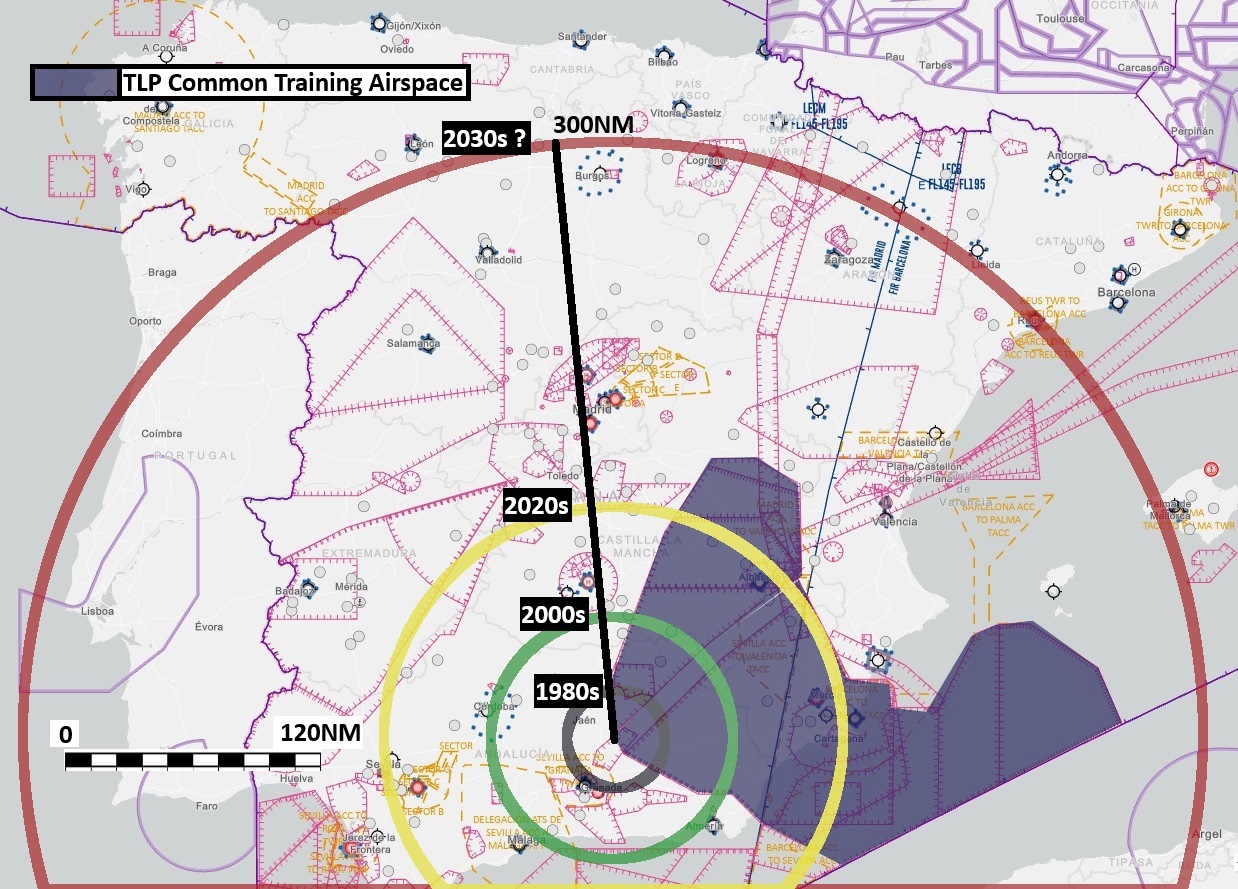
This technological leap has significantly expanded the airspace volume required for realistic training (Figure A), creating a direct conflict with civil aviation. European airspace is among the most saturated in the world, and nations remain reluctant to constrain economically beneficial air traffic. Efforts such as the Single European Sky (SES) and Flexible Use of Airspace (FUA) improve coordination but cannot increase the amount of available training airspace.
Electromagnetic Spectrum (EMS) replication: Replicating multi-domain convergence in live training is not feasible, even under optimal conditions. Space and Cyber effects are particularly difficult to replicate due to the risk of interfering with critical civil communication networks. To prepare for high-end conflict, NATO operators must be familiarised with a broad range of multi-domain effects, EMS degradation, and the resulting impact on aircraft systems and weapons performance. However, containing these effects within training-airspace boundaries is impractical, and any spillover risks interference with critical civil navigation and communication networks.
Force Design and Cost Requirements: To date, 14 NATO nations have committed to purchasing the F 35 Lightning II, adopting it as an advanced, but costly, capability upgrade over their ageing fourth generation fighters. Approximately 650 European-owned F-35s are expected to be operational by 2030, comprising roughly 20 percent of the Alliance’s 3,300 fighter aircraft inventory. This increase in capability is predicated on proficient pilots who are familiar with the range of capabilities fifth-generation aircraft can bring, and how to employ these capabilities effectively. However, rising sustainment costs and finite airframe life render flying hours an increasingly constrained resource. The Alliance must adopt an LVC model and establish the infrastructure to realise the promised benefits of this fifth-generation fleet.
Operationalising the Synthetic Roadmap
An LVC training model integrates live and synthetic technologies to create a scalable training environment. The ‘train how we fight’ concept now depends heavily on the ability to replicate an MDO environment while overcoming spatial, EMS, and economic constraints. This can no longer be achieved through the traditional combination of live‑flight training and standalone simulators. Instead, NATO should develop and normalise LVC training while preserving the essential competencies that only live flight can provide, including critical airmanship and somatosensory training. LVC comprises three distinct elements:
Live (L): Involves real people operating real systems. This remains essential for the aerodynamic and physiological effects of flight, including G-loading and somatosensory feedback. However, it is constrained by safety, cost, and the inability to replicate high-end threat density.
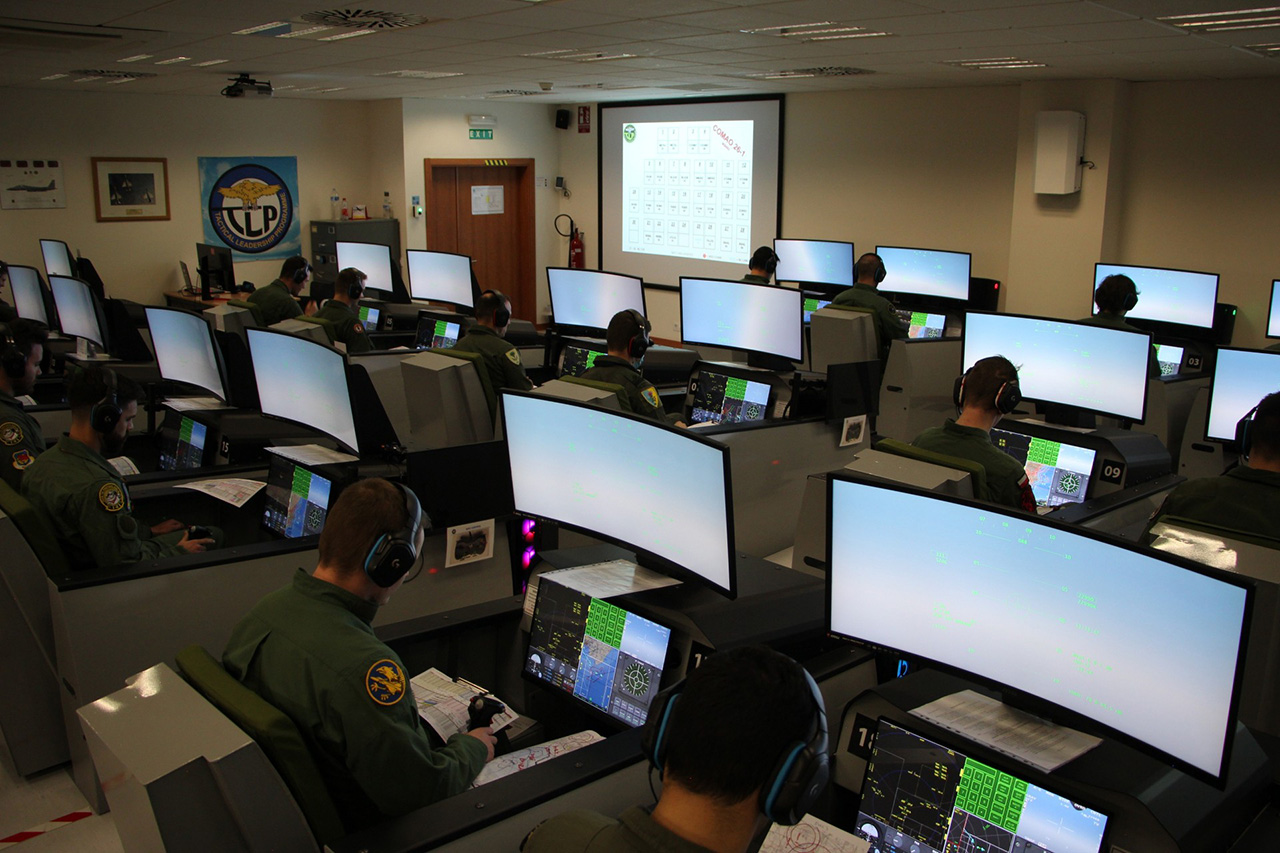
Virtual (V): Involves real people operating simulated systems. This supports mission-management training, allowing operators to master platform interfaces and HMT in a high-repetition environment without airframe wear.
Constructive (C): Involves simulated people and systems driven by computer models. ‘Constructive’ forces provide the necessary mass and complexity, generating large-scale reactive, AI-driven threats that cannot be replicated with live assets.
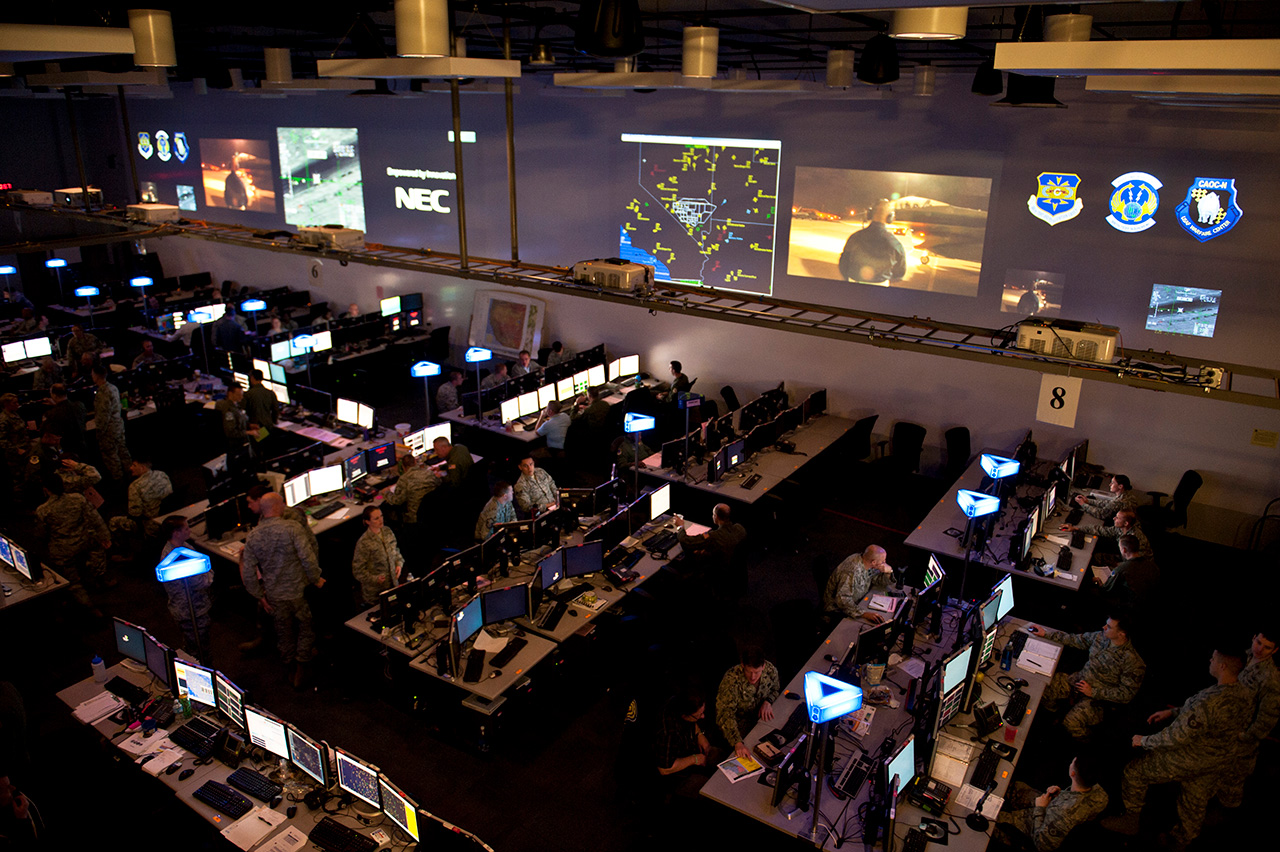
By blending these environments, a pilot in a real aircraft, live, can fly alongside a wingman in a simulator, virtual, while engaging a numerically superior force package of enemy air and land systems, constructive, in a manner that is repeatable and scalable. Organisations and nations across the Alliance have pursued initiatives that address this requirement:
- In 2019, the US Air Force launched the Rebuilding the Fighter Forge (REFORGE) concept, using advanced simulators to support basic pilot training. Components of LVC training are also used in major exercises such as Red Flag and Valiant Shield 24, where virtual and constructive assets have been integrated.
- The Netherlands Aerospace Centre, in collaboration with the Royal Netherlands Air & Space Force , focuses on user-oriented LVC concepts in air-domain training.
- The French Armed Forces have pursued the Massive Network Simulation project, Simulation Massive en Réseau (SMR), and the Jeannette system, making significant efforts to interconnect simulators.
- Within the Tactical Leadership Programme (TLP) in Albacete, Spain, the Modern Air Combat Environment (MACE), provides a high‑fidelity simulation system used to generate realistic air combat scenarios.
- The International Flight Training School in Cagliari, Italy, uses the Embedded Tactical Training System (ETTS) to enable pilots to interact in real time through LVC modes within its closed environment.
While these efforts illustrate substantial progress, they also highlight the need for a unified, Alliance‑wide framework capable of integrating and scaling such developments. In this context, NATO’s Distributed Synthetic Training (DST) initiative provides such a foundation for integration. As one of NATO’s 31 high visibility projects to boost operational effectiveness, economies of scale, and Allied connectivity, DST prepares forces for complex operational environments. DST envisions a comprehensive federation of national synthetic training capabilities to support mission readiness and high-fidelity operational training. Launched in October 2024, DST gained rapid momentum with 13 Allies signing a Memorandum of Understanding in October 2025, establishing the strategic framework upon which technical execution must now build.
Strategic Recommendations for Implementation
Establishing the Foundation: Common Reference Architecture for Interoperability. Transitioning to an LVC model requires clear doctrine and standardised architecture. Before procuring hardware, NATO should enforce common standards, such as the High-Level Architecture (HLA) and Distributed Interactive Simulation (DIS) protocols. This will ensure that national systems are not developed in isolation but are aligned with NATO reference architectures. National procurement agencies should mandate compliance with this standard for all future simulation acquisitions. Nations should still maintain the ability to operate national-only simulators for sensitive national training purposes, while a standardised architecture permits integrated coalition training when required. A simulator that cannot connect to the coalition network should be considered operationally limited for Alliance-designated training systems.
Solving the Multi-Level Security Paradox. Networked simulation increases security risk by extending connectivity beyond national enclaves. Classification and releasability constraints further impede coalition training. NATO should accelerate standardised Cross Domain Solutions (CDS) to enable real time, classification aware data exchange and prioritise secure federation over default isolation. Acquisition requirements must define both operational and training modes, allowing systems to filter data by classification and connect to coalition simulation networks while preserving the option to sequester from network risks. In practice, some operators will access the system’s full data picture while others receive only data authorised for their classification or national caveats. Embedding this dual mode architecture as a core interoperability requirement will ensure future systems support both operational employment and coalition synthetic training from the outset.
Professionalise the Synthetic Workforce. Running complex LVC scenarios requires embedded simulation structures within Combat Wings and Air Operations Centres, supported by permanent, specialised staff to manage the technical and doctrinal requirements of LVC. Yet current manning structures treat simulation support as a secondary function across most Allied organisations. Allies should consider establishing dedicated career tracks to develop specialist personnel to operate and support synthetic training systems, a specialty that may be referred to as ‘Synthetic Warfare Officer’ or ‘Synthetic Warfare Technician.’
Rebalance the Investment Portfolio. High initial capital costs for LVC infrastructure deter nations from committing to LVC infrastructure. NATO nations should shift the metric of value from ‘unit cost’ to ‘training value’, measured, for example, in repetitions or integration density, the total number of systems or platforms participating. LVC preserves airframe life and enables scenarios not feasible in peacetime live training, and this value should be weighed against the acquisition cost of LVC systems.
Conclusion
Addressing these challenges is not a technical undertaking but a strategic imperative requiring a fundamental transformation of NATO’s internal processes and culture. Current training methods are shaped for yesterday’s conflicts. To meet the demands of MDO and overcome existing constraints, NATO must shift training models towards high-fidelity LVC environments.
Live flight remains indispensable for validating aerodynamic performance, physiological stress, and integration in the physical domain. However, LVC must carry the burden of scale, repetition, and multi-domain integration required for mission-ready proficiency. As operational complexity continues to expand, synthetic environments must assume an equal role in preparing NATO aircrews for modern conflict. Because operational demands are increasing faster than live training capacity can scale, the shift toward integrated LVC is not optional, but structural.
Without this recalibration, the Alliance risks fielding fifth- and sixth-generation aircraft within a fourth-generation training construct.
Lieutenant Colonel Antonio Gutierrez graduated from the Spanish Air Force Academy in 2001 as a fighter pilot and holds a Bachelor’s degree in Industrial Organisation Engineering. He served at Ala 14 in Albacete and later as a flight instructor at the Air Force Academy, additionally flying with the Patrulla Águila aerobatic team. After completing the Staff Course and a Master’s degree in Security and Defence, he worked in the Spanish Air Operations Centre and subsequently at the Joint Operations Command. He has participated in Baltic Air Policing and EUNAVFOR Atalanta operations. In the field of simulation, he led the ´Joint Vignettes´ Focus Area during CWIX 2016 and directed the simulation team responsible for the recurrent Mazar e Sharif HQ JOC training under Resolute Support. He also headed the ITC team during the Spanish exercise DRAGON 21. He is currently assigned to the JAPCC Combat Air Branch as a fixed wing subject matter expert.