Introduction
High in the Arctic Circle, a formation of Autonomous Collaborative Platforms (ACPs) flies an intelligence, surveillance, and reconnaissance (ISR) mission to collect on enemy air defence systems. Beyond line-of-sight from any other airborne platform or ground infrastructure, the formation depends on satellite communications (SATCOM) to transmit real-time data to the operations floor. At this high latitude, however, satellites in geostationary Earth orbit (GEO) sit low on the horizon rather than overhead, so the radio frequency (RF) link is marginal.1 The ACPs collect and process vast sensor data in volumes that exceed the RF link’s ability to complete the transmission. Then the adversary begins uplink jamming the satellite. Together, suboptimal SATCOM geometry and jamming sever the connection, and the formation must return to base for maintainers to offload the ISR collection by hand. Terabytes of time-sensitive data arrive too late to act on, and the window of opportunity closes for prosecuting critical adversary targets.
This is not a speculative High North edge case in the distant future; the vulnerability exists today. Wherever modern forces operate, legacy RF links will struggle to keep pace, and adversaries who understand this vulnerability will exploit it. Recent conflicts in Ukraine and Iran have demonstrated that the electromagnetic spectrum (EMS) is contested terrain for which NATO’s communications architecture was not designed. Even in a permissive environment, current radio communication throughput is insufficient for the high-tempo, data-intensive operations of large-scale conflict. Continued reliance solely on the RF spectrum for SATCOM creates three principal challenges:
- Bandwidth Congestion: The radio portion of the EMS is increasingly crowded, necessitating constant de-confliction to avoid link fratricide.2
- Vulnerability: Traditional radio signals remain susceptible to geolocation, interception, and disruption by adversaries.
- Throughput Deficits: The multi-Gbps data rates required for data-sharing at the edge exceed the capacity of many legacy RF links.3

The EMS plotted logarithmically, where each tick marks a tenfold increase in frequency. The entire RF spectrum fits below 300 GHz. Optical SATCOM operates in the near-infrared, more than two orders of magnitude higher, where correspondingly more bandwidth is available. © JAPCC
Shifting Up the Spectrum
To overcome those three challenges, the Alliance requires additional pathways that reduce reliance on congested and contested RF SATCOM while increasing throughput, all without creating a new generation of national or commercial solutions that complicate interoperability. Instead of radio waves, optical SATCOM (also known as laser SATCOM) transmits data as pulses of infrared light between terminals, similar to how fibre optic transmissions function terrestrially. It addresses the three challenges of sole reliance on RF SATCOM:
- Reduction of Bandwidth Congestion: Unlike the RF spectrum, which the International Telecommunication Union (ITU) partitions and regulates, the optical spectrum is vast and currently free from regulatory licensing hurdles.4 This allows Allies to bypass the years-long frequency coordination process and avoid the spectrum congestion when multiple users compete for limited frequency slots.
- Inherent Security: The narrow beam of a laser, often compared to hitting a basketball hoop from hundreds of kilometres away, fundamentally changes the detectability dynamic.5 These optical links provide inherent Low Probability of Intercept (LPI) and Low Probability of Detection (LPD), making them far less susceptible to the signals intelligence (SIGINT) and electronic warfare (EW) campaigns that challenge today’s RF systems.
- Orders-of-Magnitude Throughput Increase: Operating at frequencies far above the RF spectrum, optical links provide the capacity necessary for future network-centric warfare. Against narrowband systems such as Ultra High Frequency (UHF) SATCOM, optical terminals deliver improvements of more than four orders of magnitude.6 Even compared to wideband systems in the Ku-band, optical links offer roughly two orders of magnitude more throughput today.
These benefits, however, depend on close Allied coordination.
Upgrades Across NATO’s Space Segments
To prevent disparate national procurement efforts from creating an incoherent Alliance architecture, NATO should adopt a common Optical Communication Terminal (OCT) standard and use the NATO Defence Planning Process (NDPP) to synchronise growing Allied and commercial momentum into an interoperable network backbone.
NATO’s space architecture comprises four segments: the orbital (or space) segment consisting of the satellites themselves; the terrestrial (or ground) segment used to manage the architecture; the user segment of warfighting platforms and devices; and the link segment that connects them to one another. While optical communications represent a modernisation of the link segment, this upgrade is only effective when the nodes are optical-capable. If an orbital, terrestrial, or user segment lacks a compatible OCT, it cannot participate in the high-throughput and secure optical communications architecture. Fortunately, upgrades at each of these nodes are already underway. Allies and industry have achieved proof-of-concept milestones across all segment types, as seen in Table 1.
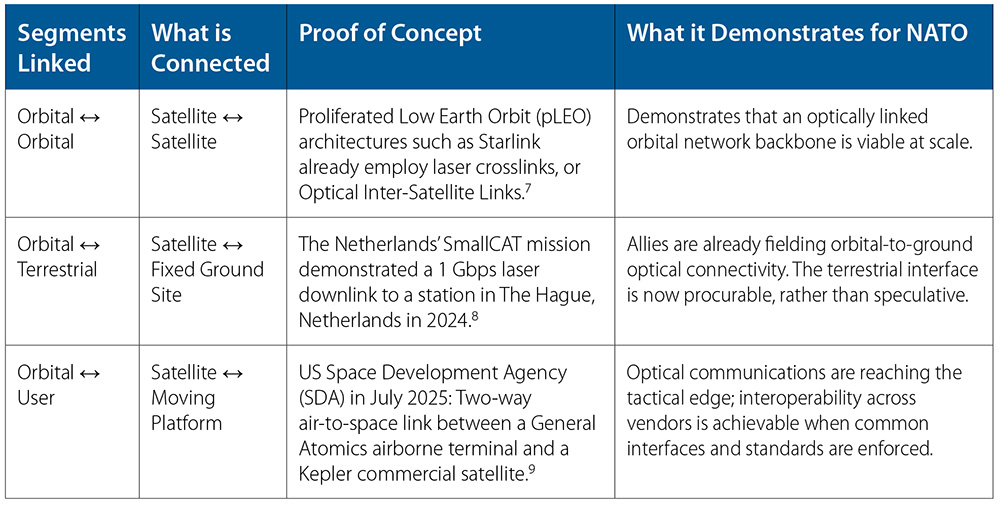
Table 1: Demonstrations of space segments linked by optical communications. © JAPCC
The US Space Force’s SDA demonstration is particularly significant because different commercial vendors from different Allied nations provided each end of the SATCOM link via a common standard. This validates a coalition model in which nations procure hardware from their preferred domestic vendors while remaining part of a single interoperable Allied architecture.
Reality Check
While optical communications offer a transformative leap in capability, they are not a singular replacement for RF SATCOM links due to the physics of the medium. Unlike many radio waves, which penetrate most atmospheric conditions, optical links to and from space suffer significant attenuation from clouds, fog, and precipitation. Orbital crosslinks between satellites are unaffected, but for the ground and user segments, a reliable backbone requires diverse pathways that integrate optical communications into a broader architecture rather than relying on them alone. Promising research suggests a rotating outer laser beam could shield a signal-carrying beam through cloud and rain, though the work remains at the laboratory stage.10 In the meantime, this is not an unfamiliar problem. Atmospheric conditions already degrade the higher frequencies of today’s SATCOM, such as Ka-band and Extremely High Frequency (EHF), so procedures to manage those challenges are already established.
Additionally, the precision that provides optical links with their security also introduces significant pointing, acquisition, and tracking (PAT) demands. Establishing a link between a satellite moving at approximately 8 km/s11 and an airborne platform requires near-perfect alignment. This precision requires sophisticated hardware capable of maintaining consistent line of sight in a dynamic battlespace.

The diagram above illustrates the PAT process for establishing an optical communications link between two terminals. Beginning with coarse pointing, where both terminals scan a wide angular area, the beam progressively narrows through successive acquisition phases until a precise, stable link is achieved. © Courtesy of The MathWorks, Inc.
To weigh the operational advantages against their physical limitations, as shown in Table 2 on page 56 compares the trade-offs between traditional SATCOM and emerging optical systems.

Table 2: RF vs optical communications. © JAPCC
Finally, beyond the physical constraints, the political dimension presents its own challenges. NATO’s consensus-based framework and national industrial interests make standardisation difficult to enforce. The same sovereign preferences that produced today’s fragmented network architecture could repeat themselves with optical SATCOM if left uncoordinated. However, an early standard does not require the same amount of enforcement as one developed later. A public standard from the outset creates an adequate incentive, as vendors build to the specification that maximises their addressable market. This is why achieving optical standards before the technology’s proliferation is essential.
Recommendations: Synchronise Momentum into an Interoperable Architecture
NATO does not own or operate satellites, relying instead on national and commercial space data, products, and services made available to the Alliance. Plus, few nations can build a complete optical backbone across all space segments alone. Therefore, NATO must ensure sovereign national and commercial optical space capabilities remain usable by the Alliance through interoperability standards, NDPP alignment, and OCT procurement that keeps pace with national and commercial innovation. Three concrete steps can translate this momentum into an interoperable Alliance architecture.
Step 1: Standardise OCT Interfaces
The first step is adopting a baseline OCT standard. The 2025 SDA demonstrations prove that when interface design has open standards, multi-vendor interoperability is achievable. By adopting OCT specifications under a NATO Standardization Recommendation (STANREC) first and then escalating to NATO Standardization Agreement (STANAG) as the technology matures, NATO can ensure national procurements are interoperable by design. An open standard could prevent vendor lock-in and ensure that a ground terminal from one nation can natively link to another nation’s optical terminal in orbit.
Two such specifications already exist, and they are compatible. The SDA has an open OCT standard which derives largely from existing international and civil optical specifications rather than any design unique to the US military.25 The European Space Agency’s specification for optical links incorporates requirements in line with the SDA standard, along with commercial fibre standards for the highest data rates.26 A common transatlantic baseline therefore already exists for the rates being fielded today. That window may not stay open indefinitely, so NATO should act now to codify the areas where the two specifications are already synchronised.
Step 2: Align National Investments Through the NDPP
The Alliance must translate these standards into specific capability targets via the NDPP. The NDPP can specify a defined percentage of national SATCOM investment to meet the NATO optical baseline. This allows NATO to steer national decisions towards interoperable technologies without requiring a central budget for satellite ownership. Because PAT technology for tactical platforms is still maturing, the NDPP should prioritise the orbital backbone first, specifically inter-satellite crosslinks and terrestrial segments. User segment investment can proceed in parallel as standards solidify. The result is a networked mesh of interoperable terminals in orbit and at ground stations, which tactical platforms can join as their own technology matures.
Step 3: Integrate a Trailblazer
NATO should designate a test case from among its organic missions or Allied multinational projects. This could be a NATO SATCOM ground station, the NATO ISR Force, NATO Airborne Early Warning and Control Force (NAEW&FC), Hybrid Alliance Layered Operations in Space (HALO),27 or the NORTHLINK Arctic communications project.28 NATO can then begin incremental integration into this architecture.
A test case serves a purpose beyond communications. It demonstrates Alliance commitment to emerging technology, identifies interoperability gaps early, and builds the institutional experience needed to scale. Because atmospheric factors like cloud cover will remain a persistent constraint on ground and user segments, this transition should follow a hybrid-by-design logic. Rather than fully replacing RF, NATO should build redundancy into the architecture, maintaining mission-critical data flows via RF while leveraging the full throughput of optical links when conditions permit.

An orbital-to-terrestrial optical downlink connecting a satellite terminal to a ground station. Proof-of-concept demonstrations of this link type are already operational among NATO Allies. © Courtesy of NASA
Conclusion
NATO cannot control how aggressively an adversary contests the EMS, but it can determine whether its procurement strategy produces a resilient, interoperable Alliance architecture or a collection of isolated national endeavours. The standards must be set now, before national procurements lock in incompatible interfaces.
Consider again the opening vignette. Had the mission been equipped with optical SATCOM alongside its RF links, the jamming that severed the uplink would not have been the end of the story. Hours of time-sensitive intelligence could have found an alternative pathway, one that is narrow and invisible to the adversary. That redundancy is achievable. Whether it exists when needed depends upon the decisions NATO makes today.